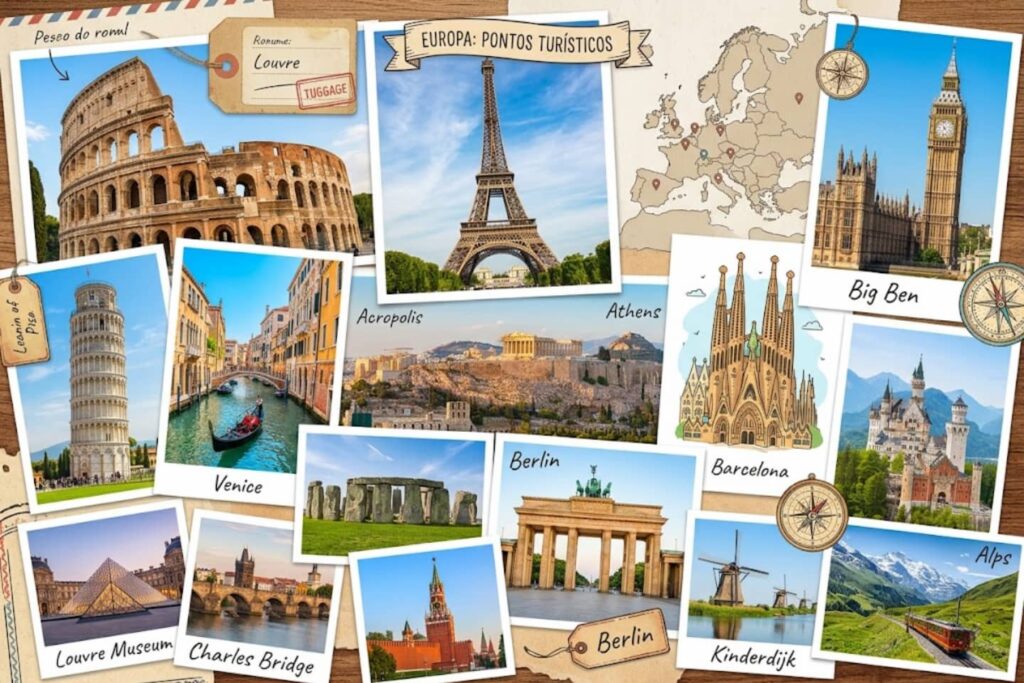
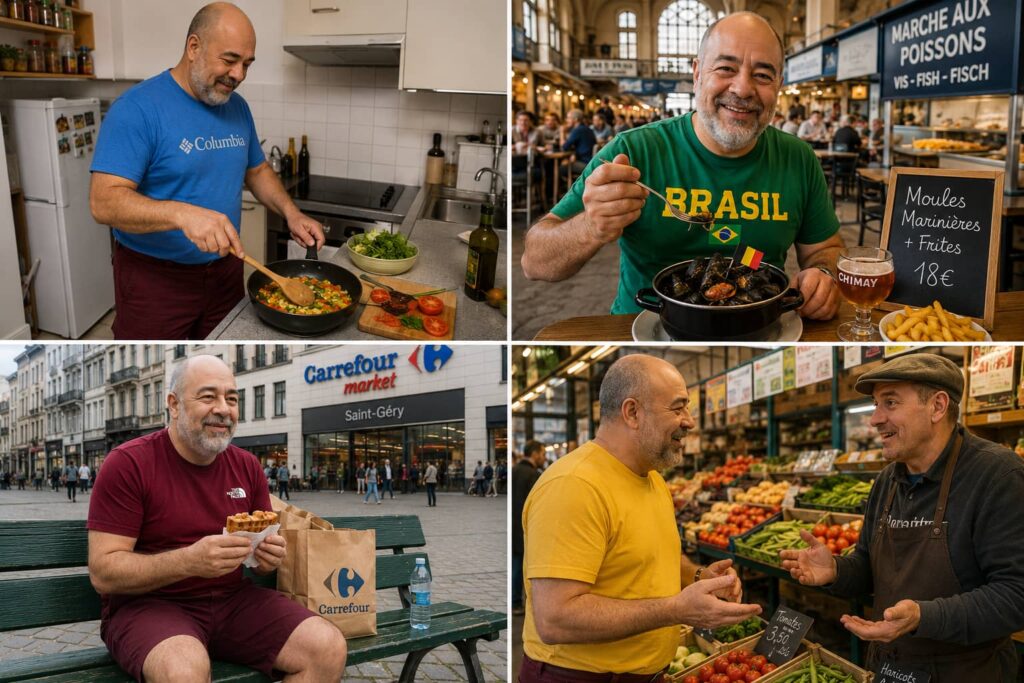
Have you ever heard of Grocery store tourism?
Before discussing Grocery store tourism, understand that traveling the world without a rigid itinerary completely transforms our perception of places. Many people find it very difficult to detach themselves from traditional tourist guides, as they believe that a lack of planning only creates problems.
However, I guarantee that true connection with a new culture happens when we allow spontaneity. In this article, you will learn how to break free from the tourist trap.
One of my oldest practices is to always visit local markets, where people actually buy their products.
The best local food is also there, including many dishes that most tourists have never heard of.
It doesn’t mean that eating at a good restaurant is bad, but it’s not the food that the local people eat.
Local cuisine
Of course, you can’t go to Paris without seeing the Eiffel Tower, eating a croissant, drinking French wine, etc.
However, to experience Paris as it truly is, you need to get off the beaten tourist track.
Nothing is more authentic than food made and eaten by the people. Parisians and you certainly won’t find this food in a restaurant on the Champs-Élysées.
I’m not saying that good restaurants or tourist attractions should be abolished.
However, to experience the real Paris, one must get lost in the local streets and markets.
See The skills of the independent traveler
What is Grocery store tourism?
Imagine trading the endless queues at the Louvre or the Colosseum for the colorful aisles of a supermarket. Whether in Paris, Tokyo, or New York. That’s the essence of Grocery store tourism, a global trend where travelers explore local markets as if they were veritable museums of pop culture and gastronomy.
Instead of postcards, the souvenirs from the trip are exotic spices, limited-edition sweets, and snacks with flavors that don’t exist in the country of origin.
This new trend that’s taking the world by storm — and flooding social media — is much more everyday, authentic, and delicious: visiting local supermarkets.
For me and many travelers, the true soul of a country isn’t in museums. It’s on supermarket shelves. Discovering unique products and observing the daily lives of locals has become the perfect plan for those seeking an unfiltered cultural immersion.
Traveling is about connecting with reality. And nothing is more real than everyday shopping.
How did this phenomenon arise?
This practice of browsing local markets has always existed among the more curious travelers.
As one of these travelers, I always sought out these places because they were closer to the people.
It gained the status of a cultural trend thanks to two main factors: the rise of short-term rentals and the impact of social media.
With the popularity of platforms like Airbnb, tourists gained access to their own kitchens, sparking interest in buying local ingredients for cooking. Almost simultaneously, visual platforms like TikTok and Instagram transformed the aisles of Walmart, 7-Eleven, or Lawson into perfect settings for viral videos. Content creators began sharing their “treasure hunts” for rare products, inspiring millions to do the same.
Due to costs and other factors, traditional supermarkets themselves have started offering food. Many tourists buy their food at the supermarket and use the public spaces to eat it.
Today, visiting a foreign supermarket is a form of everyday anthropology. It allows one to observe the daily routines of local residents, understand their consumption habits, and experience the culture through taste.
This also saves a lot on food.
It proves that the authenticity of a destination is often hidden in the simplest things of everyday life.
Check out this article on why we love shopping at supermarkets abroad.
What is my strategy within Grocery store tourism?
When I started traveling, this classification didn’t exist yet, but the idea was exactly the same.
I always make a point of visiting the municipal markets and spending a few hours exploring their aisles. After all, that’s where local life happens in its most authentic way.
Markets are true sources of information and knowledge. Besides observing the products and customs of the region, it’s worthwhile to talk to the vendors and regulars. Most of the time, people are willing to share stories, traditions, customs, and a bit of the popular wisdom that is part of everyday life.
Furthermore, it is in the markets that we generally find the most authentic cuisine, with typical ingredients, traditional dishes and, often, flavors that would be difficult to find in restaurants aimed at tourists.
However, it is important to keep in mind that some markets have become such famous attractions that they have lost part of their original function as a shopping center for the local population.
In São Paulo, for example, the São Paulo Municipal Market, known as Mercadão, is an interesting place to visit. However, because it is quite touristy, sophisticated, and relatively expensive, it is not part of the shopping routine for most city residents.
In Budapest, the Central Market (Great Market Hall / Központi Vásárcsarnok) also attracts a large number of visitors. Meanwhile, many locals prefer to do their shopping at local farmers’ markets, such as Közös Piac on Király Street, where the experience is often closer to the everyday reality of the city.
The taste of authenticity on the shelves.
This change in behavior reflects a deep desire for spontaneous experiences. Countries like Japan and the United States lead the list of preferred destinations for this practice. In these places, travelers find true gastronomic treasures:
- In Japan:Your matcha kit-Katsake, furikakeand snacks ofwasabi.
- In the US:Limited editions of chocolates and soft drinks that never reach Europe.
The data confirms thephenomenonApproximately 77% of travelers have already embraced Grocery store tourism to discover local delicacies, and 35% plan to repeat the experience on their next adventure.
Interesting facts that only exist in Grocery store tourism.
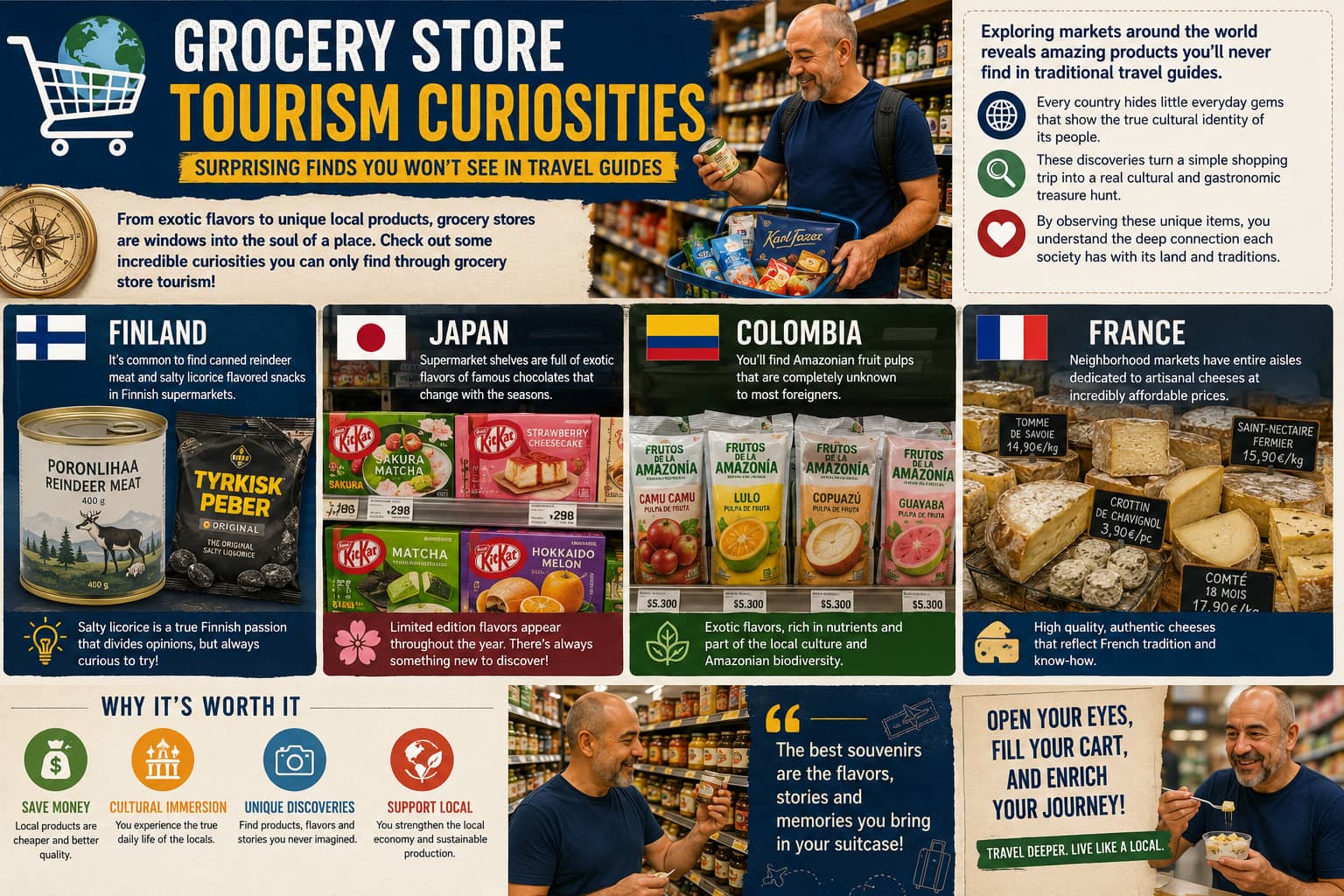
Exploring markets around the world reveals surprising products you’ll never find in traditional guidebooks. Each country hides small everyday gems that showcase the true cultural identity of that specific population. For example, in Finnish supermarkets, it’s common to find canned reindeer meat and salty licorice-flavored snacks. Similarly, in Japan, shelves display dozens of exotic flavors of famous chocolates that change with the seasons.
Furthermore, in Colombia, customers find Amazonian fruit pulps completely unknown to most foreigners. In France, neighborhood markets dedicate entire aisles to artisanal cheeses at incredibly affordable prices. Therefore, these discoveries transform a simple purchase into a true cultural and gastronomic treasure hunt. Thus, by observing these peculiar items, you understand the relationship that each society maintains with its own land.
Why do we trade monuments for shopping?
The reportTravel Trends 2026This shows that the interest goes far beyond simply filling a shopping cart. It’s a form of exploration. Travelers are looking for:
- New flavors:Discover typical foods and drinks (36%).
- Curiosity:Trying local versions of well-known brands (31%).
- Cultural anthropology:Observe the country’s lifestyle and daily life (29%).
The growth of accommodations with their own kitchens, such as Airbnb, has further boosted this habit. Cooking with local ingredients at the end of the day brings the traveler closer to the city’s routine. It transforms the trip into a real experience.
From shelf to suitcase: The supermarket has become the new souvenir shop. Instead of fridge magnets or postcards, travelers bring back spices, rare sweets, and exotic snacks to give to friends.
NOTE: Observe the transport regulations for these products. In general, anything that is industrially packaged can be transported. Avoid buying in bulk.
A new way of seeing the world
From large supermarkets like Walmart and Costco to iconic Japanese convenience stores like 7-Eleven, Lawson, and Family Mart, these spaces have become the new must-see tourist attractions.
Grocery store tourism proves that the beauty of travel lies in the small details. Mingling with locals, trying to decipher labels in an unfamiliar language, and venturing into new flavors brings a unique freedom.
Ultimately, a people’s culture can also be known through its food. And a visit to the neighborhood supermarket can be as enriching—and surprising—as contemplating Big Ben.
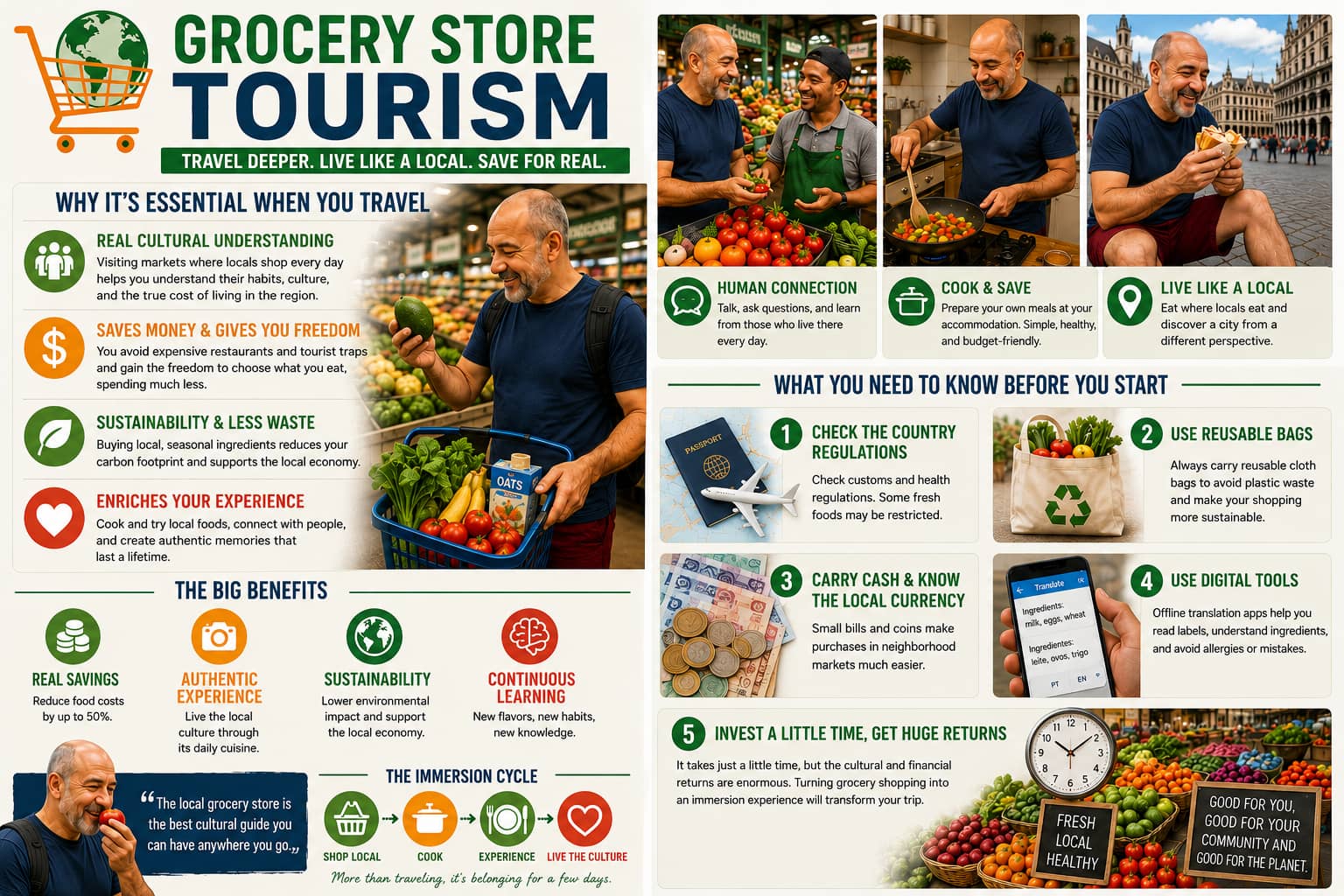
Why Grocery store tourism is essential for travel.
Understanding the daily routines of local residents is the first step towards a truly immersive trip. Currently, the tourism market pushes travelers towards expensive restaurants and crowded spots, distancing people from the reality of the country.
For this reason, practicing Grocery store tourism has become an essential tool for those seeking autonomy and real savings. When you visit markets frequented by the local population, you understand the habits, culture, and true cost of living of that region.
Furthermore, this practice directly supports ecological sustainability and the reduction of resource waste. Eating at establishments catering solely to foreigners usually generates a much larger carbon footprint due to the importation of supplies.
On the other hand, by selecting seasonal ingredients and regional products from local shelves, you consume consciously. This smart habit not only significantly protects your budget but also enriches your cultural repertoire through everyday cooking.
What you need to know before you begin.
Before aimlessly wandering through the world’s markets, you need to understand some basic preparation rules. First, check the customs and health regulations of the country you are visiting, as the entry of certain fresh foods may be prohibited.
In addition, always bring reusable cloth bags to avoid unnecessary plastic consumption during your daily shopping. Knowing the local currency and having small amounts of cash also makes it easier to interact in neighborhood markets.
Another important point involves the use of simple digital tools, such as translation apps that work without an internet connection. They help decipher complex labels and avoid allergies or unpleasant surprises with unknown ingredients.
The time required for this activity is minimal, but the cultural and financial reward is immense. Knowing this, you’ll be ready to transform the act of packing your backpack into a true immersion in local customs.
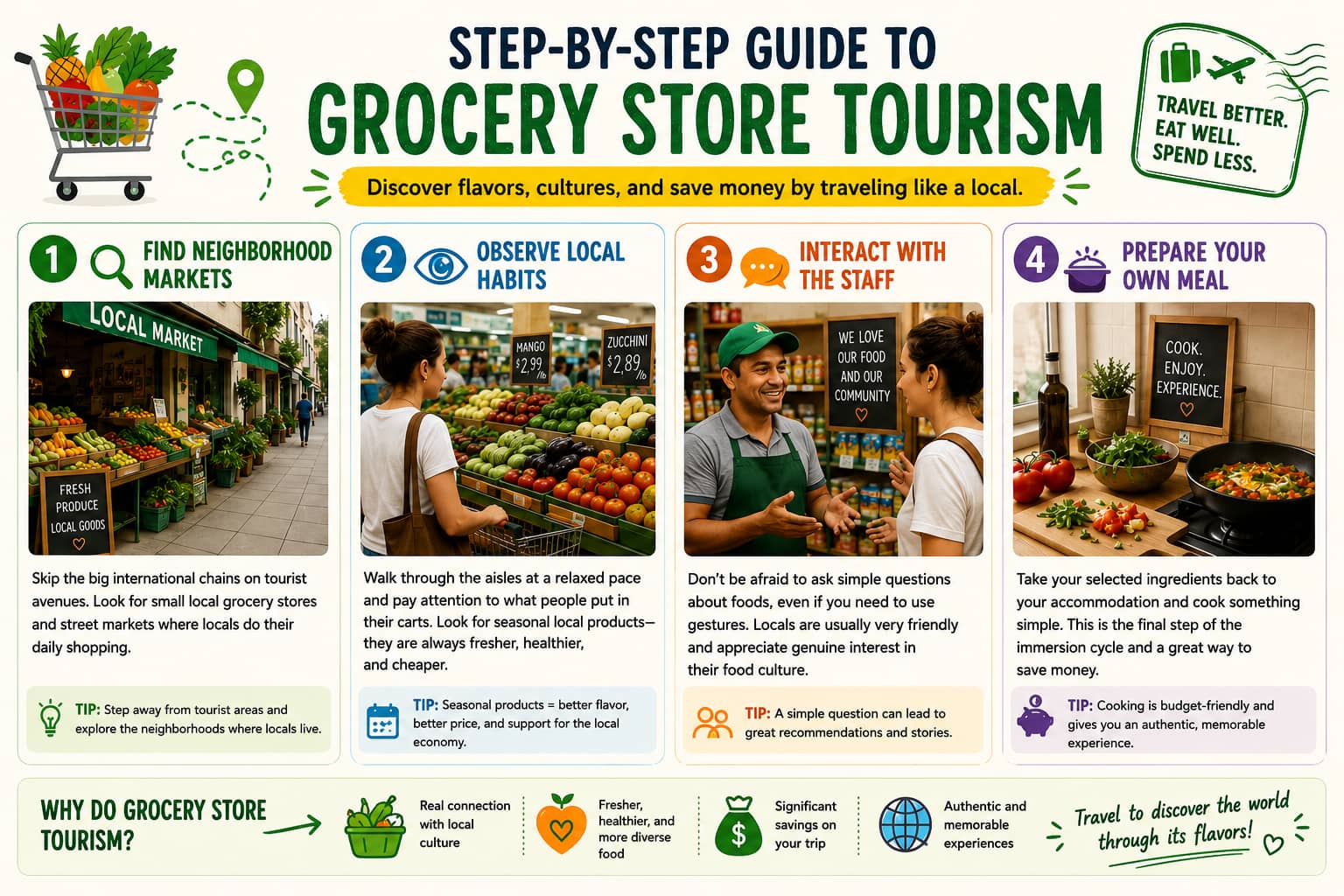
Step-by-step guide on how to do Grocery store tourism.
Step 1 – Locate neighborhood markets
Forget the large multinational chains located on the city’s tourist avenues. Seek out small residential establishments and street markets where locals do their daily shopping.
Step 2 – Observe local customs
Walk calmly through the aisles and observe what people are putting in their shopping carts. Identify the seasonal products that are local, as they are always fresher, healthier, and cheaper.
Step 3 – Interact with employees
Don’t be afraid to ask simple questions about the food, even if you need to use gestures. Locals are usually very receptive when they perceive a genuine interest in their food culture.
Step 4 – Prepare your own meal
Take the selected ingredients to your accommodation and cook them simply. This process completes the immersion cycle and guarantees significant savings in financial resources.
Essential tips that can make your routine easier.
To make your routine easier and improve your experience, try to visit the markets during off-peak hours. Early morning or late afternoon are ideal times to observe real life without feeling rushed.
Consequently, employees will be freer to chat and offer valuable recommendations about typical products. Another excellent trick is to research which simple traditional dishes locals prepare in their own homes every day.
Additionally, use map apps that show the location of organic markets and independent local producers. These free tools help you find real hidden gems far from traditional tourist maps.
Remember also to observe where local workers buy their quick meals to take away. Copying these simple behaviors ensures that you will consume high-quality food for a fraction of the price charged in tourist centers.
Common mistakes you should avoid
The most frequent mistake made by those attempting Grocery store tourism is to only seek out well-known brands from their home country. By doing so, travelers spend a lot of money on imported products and miss the opportunity to try new local flavors.
Therefore, free yourself from food prejudices and take a chance on less famous regional brands. Another serious misconception involves wasting food by buying excessive portions that will not be consumed during the stay.
Furthermore, never ignore the reusable bags and recycling policies of the establishment you are visiting. Many European countries charge extra fees for plastic bags andrequireThe customer weighs the fruit beforehand.
Failing to observe these small rules of etiquette can lead to uncomfortable moments at the supermarket checkout. Pay attention to the signs, observe the behavior of those around you, and learn from local customs.
Is Grocery store tourism worth it?
Without a doubt, this strategy is well worth it for anyone seeking freedom and authenticity around the world. The main advantage lies in breaking down the invisible barrier that separates the tourist from the local community being visited. Furthermore, the financial savings generated allow you to extend your trip for weeks or even months. This approach is highly recommended for backpackers, long-term travelers, and enthusiasts of ecological sustainability.
On the other hand, there are obvious limitations if you have very little time available at your destination or if you hate cooking.
If your accommodation doesn’t offer a kitchen, preparing complete meals becomes a bit more complex.
However, even in these situations, you can still use markets to buy quick snacks, fresh fruit, and water. The cultural benefits of strolling among the local aisles outweigh any minor logistical difficulties.
Conclusion
Traveling spontaneously and embracing Grocery store tourism transforms our relationship with the planet. This simple practice reduces costs, avoids wasting precious resources, and promotes genuine human encounters in the aisles of the world. After all, the best memories of a journey are not in postcards, but in the stories shared with local people.
I hope these essential tips inspire you to ditch the pre-planned itineraries and seek out your next adventure.
Frequently Asked Questions (FAQ)
Does Grocery store tourism work in every country?
Yes, because all cultures around the world have markets where the local population buys supplies daily. This practice is universal and works perfectly in both large European metropolises and small villages in the Asian countryside.
How much can you save with this strategy?
On average, you can reduce your food costs by up to 40% compared to eating daily at tourist restaurants. This savings allows you to invest resources in other memorable experiences during your trip.
Do you need to know the local language to shop?
It’s not mandatory to be fluent in the native language of the region you’re visiting. Genuine smiles, polite gestures, and basic translation apps on your phone are sufficient tools to ensure efficient and respectful communication with the locals.