
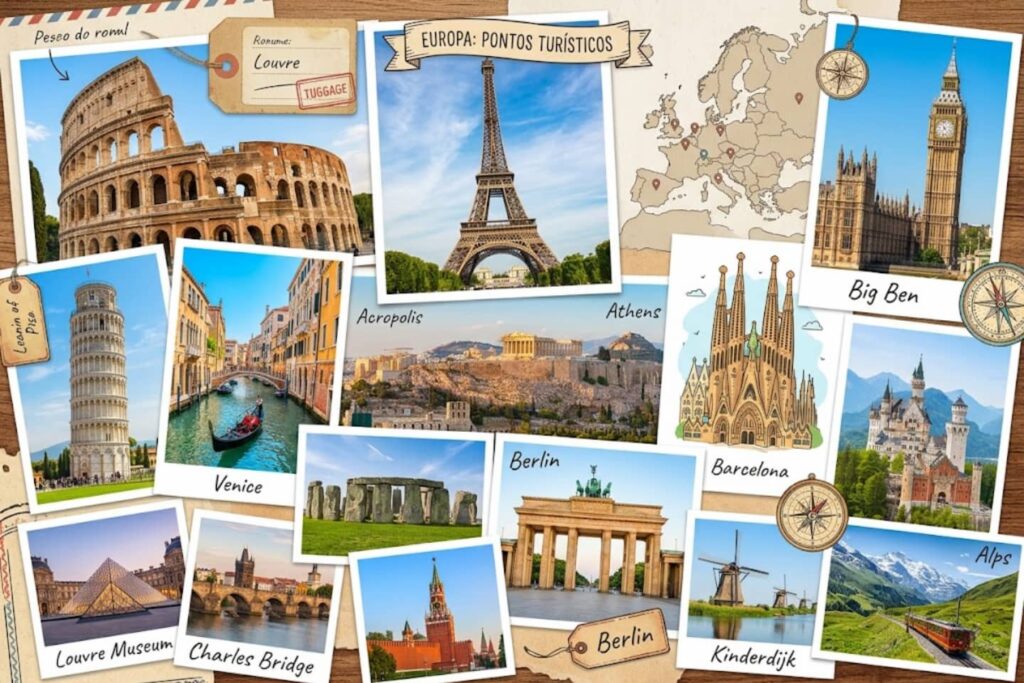
Traveling around Europe is a dream for many Brazilians seeking history and culture. However, the planning process often raises questions about logistics and costs.
I’ve travelled around many European countries, and I can guarantee that autonomy is the best way to experience the continent. You’ll have the freedom to change the course of your journey and discover villages that don’t appear on traditional tourist maps.
In this article, you will learn how to organize your trip from scratch, from choosing your destination to managing your finances.
First, understand that Europe is extremely well-connected, which makes life much easier for solo travelers. Furthermore, the focus here is on an immersive and sustainable experience. We’ll explore how to use trains, choose accommodations that respect local culture, and save money without sacrificing quality.
Prepare yourself for a journey of self-discovery. Certainly, by the end of this text, you will feel confident enough to book your ticket. The goal is to transform complexity into a practical and exciting roadmap.
So, keep reading to master the strategies of an experienced traveler.
Why traveling independently around Europe is essential.
Choosing to travel around Europe without agencies allows for a much deeper connection with the environment. When you decide your own schedule, you have time to talk to locals and understand their customs. Rigid tours often keep travelers in a bubble, preventing spontaneous and memorable experiences.
On the other hand, independence requires responsibility and thorough prior research. This initial dedication translates into real savings, as you avoid intermediary fees and choose fairer services.
Beyond the financial aspect, sustainability gains importance in individual planning. You can choose to walk more and use the efficient public transportation that the continent offers.
Similarly, traveling at your own pace reduces stress and allows you to appreciate each monument or landscape you visit. Europe rewards those who are curious to look beyond the obvious.
Thus, you cease to be merely a spectator and become part of the scenery. The true lesson learned in each country comes from the freedom to get lost and discover something surprising. It is this authenticity that defines an unforgettable and transformative trip.
What you need to know before starting your journey.
Before packing your bags for a trip to Europe, some technical points are essential. The first is checking the validity of your passport, which must be valid for at least six months. In addition, most countries require mandatory travel insurance with specific coverage.
Without this document, you may be denied entry to the Schengen Area at immigration. Another important factor is currency exchange; it is advisable to diversify between cash and multi-currency cards. This ensures security and better conversion rates during travel.
Also check the weather in the region during your chosen time to avoid excess baggage. A light backpack makes using trains and buses easier and consumes fewer natural resources.
Research the baggage rules of low-cost airlines, as they are quite strict. Regarding costs, plan a daily budget that includes food, local transportation, and museum entrance fees.
Having this information at hand reduces anxiety and avoids serious financial surprises. Preparing in advance is the secret to having peace of mind and focusing only on having fun.
This way, you start your adventure on the right foot and with an open mind to new experiences.
Dream trip, 15 foolproof tips to avoid worrying about costs.
Step-by-step guide to planning your trip around Europe.
Define the itinerary and length of stay.
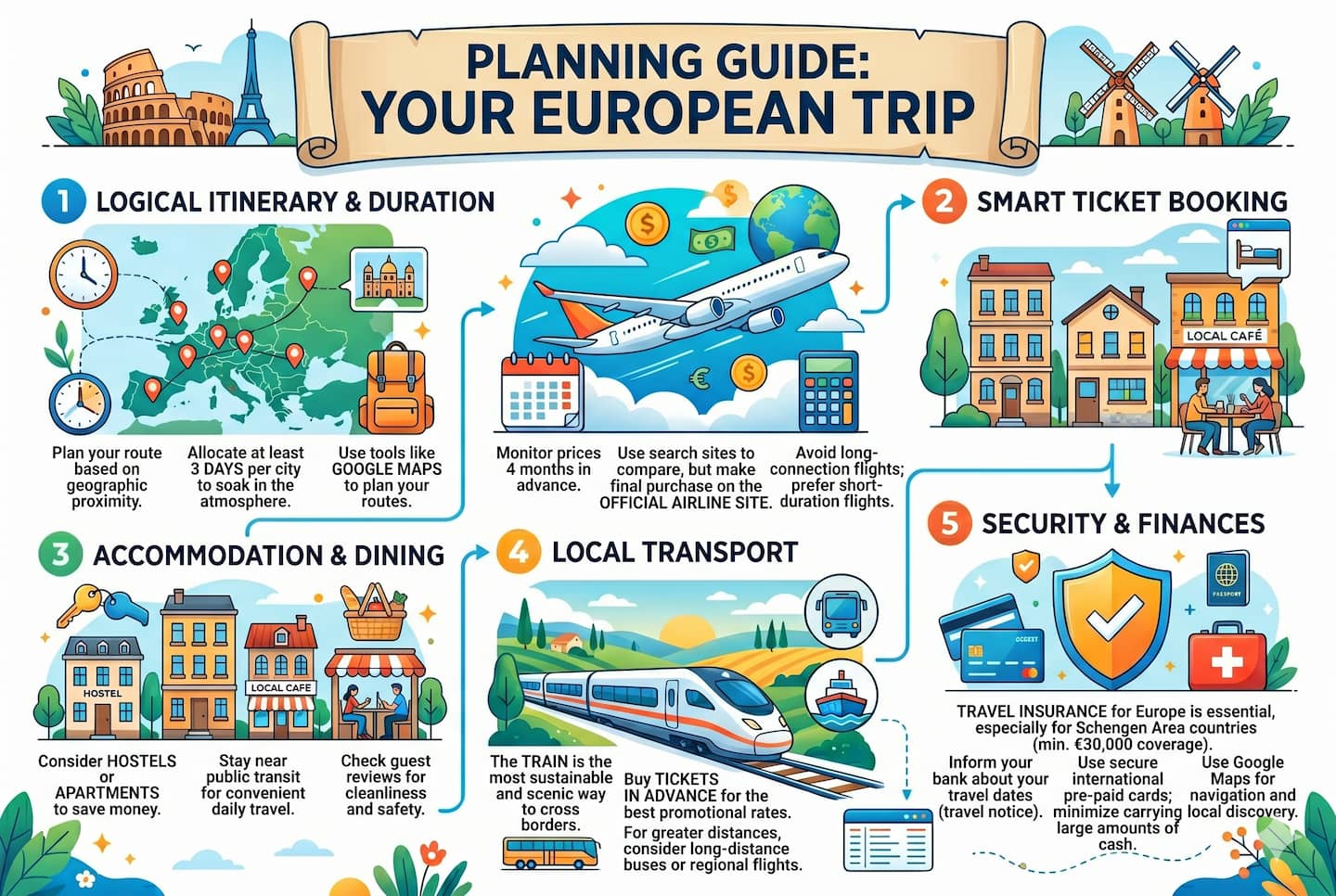
The most common mistake when planning a first trip to Europe is trying to see the entire continent in ten days. The result is a collection of airport photos and extreme exhaustion. For a smart itinerary, open a map and identify geographical clusters.
If you want to see the Iberian Peninsula focus on Portugal and Spain. If you prefer…Europa Central Combine Prague, Vienna, and Budapest. Geographical proximity reduces travel time and allows you to cross borders by land, which is much more visually rich.
Establish a golden rule: three full days per city The first day is for getting acquainted with the area and overcoming jet lag. The second day allows you to visit the main monuments.
The third stage is where the magic happens: it’s when you stop looking at the map, discover a café off the beaten tourist track, and begin to understand the rhythm of that culture.
Use Google Maps to create layers with points of interest and check the feasibility of the routes. Remember the time spent between checking out of one hotel and checking into the next consumption of at least half a day.
In your trip around Europe Smaller cities with more depth always yield better stories than a hastily crossed-off list of countries.
Buy your tickets wisely.
When traveling around Europe Airline tickets are usually the biggest expense of a trip, so the purchasing strategy must be surgical. Monitoring should begin around four to six months before the match.
Use search tools to identify price patterns and cheaper days of the week—flights on Tuesdays and Wednesdays usually have reduced fares. A valuable technique is…the multi-segment passage. Where you arrive in one city (like Madrid) and return from another (like Berlin). This saves you time and money by avoiding returning to your point of origin just to catch your return flight.
When you find the ideal price, always prefer to complete the transaction on the airline’s official website. This makes it easier to get support in case of cancellations or changes.
Avoid excessively short layovers at gigantic airports like Heathrow or Charles de Gaulle; a twenty-minute delay can ruin the start of your trip.
If your time is short, prioritize direct flights, even if they cost a little more. The value of arriving rested and gaining six hours for exploration is worth the price difference.
Also pay attention to the airlines’ baggage fees. Low-cost European companies, which can turn a cheap offer into an unexpected cost at the check-in counter.
Book authentic and sustainable accommodation.
Traveling around Europe. The place where you sleep sets the tone for your connection with the destination. Instead of standardized chain hotels that isolate the traveler from the local reality, look for alternatives that promote the neighborhood economy.
Family pensions, small boutique hotels offer personalized service and tips not found in guidebooks. If you’re traveling alone and seeking interaction, these…modern hostels. They have private rooms and common areas that make it easy to meet other explorers.
For longer stays, renting an apartment from a local allows you to frequent the corner market and cook with regional ingredients, experiencing the city’s daily life.
Sustainability in accommodation also depends on location. Choose neighborhoods that allow you to do as much as possible on foot or that are just steps away from a metro or tram station.
This reduces your carbon footprint and saves you a fortune on taxis or ride-sharing apps. Before booking, delve into recent reviews. Look for specific comments about Wi-Fi quality, nighttime noise levels, and neighborhood safety after dark. A comfortable bed in a vibrant neighborhood is the haven you need to recharge after miles of walking.
Organize internal transportation between cities.
The European rail network is undoubtedly the lifeblood of the continent. Traveling around Europe by train is a choice that combines charm, comfort, and environmental efficiency. Train stations are usually located in the city center, eliminating the need for expensive journeys to outlying airports.
To guarantee the best prices, buy high-speed tickets (like the TGV, AVE or Eurostar) Book your trip approximately 90 days in advance. Promotional fares sell out quickly, and the counter price at the time of travel can be prohibitive.
For those traveling on a tighter budget, long-distance buses are modern and very inexpensive alternatives, ideal for journeys of up to five hours.
If the distance is very long, such as from Lisbon to Warsaw, domestic flights become unavoidable but try to balance the itinerary so that most of the travel is done by land.
Also consider night trains, which are making a strong comeback in Europe; they allow you to save on a hotel night and wake up already at your next destination. Regardless of your choice, always have your ticket saved on your phone and a printed version for emergencies.
Planning your transportation in advance removes the stress of borders and allows you to focus solely on the scenery passing by the window.
Travel Insurance and the Schengen Agreement
To understand the importance of insurance, one must first understand…Schengen Treaty This is an agreement between more than 25 European countries that establishes the free movement of people. For travelers who do not require a prior visa, such as Brazilians, entry into this zone requires proof of travel insurance with a minimum coverage of…30,000 euros for medical assistance due to illness or accident.
When traveling around Europe, have your printed insurance policy on hand at immigration; you run a real risk of being denied entry, even if you have return tickets and hotel reservations. This stipulated minimum amount is not arbitrary; it aims to ensure that the visitor has the resources to cover hospital care or, in extreme cases, medical repatriation, without burdening the local public health system.
However, the choice of insurance should go far beyond the minimum required by law. A good plan should be comprehensive, covering not only last-minute medical emergencies, but also logistical mishaps that could ruin a trip’s budget.
Check if the policy includes coverage for lost luggage Flight cancellations and legal assistance. In countries where the cost of living is high, such as Switzerland and Norway, basic healthcare can quickly exceed the limits of even very cheap insurance.
Therefore, assess the profile of your trip: if you intend to practice winter sports in the Alps or do extensive hiking, make sure that the plan specifically covers “risky activities”.
Having 24/7 support available, with service in Portuguese, offers the peace of mind needed to focus on what really matters: exploring and connecting with new cultures, knowing that you won’t be helpless in the face of the unexpected.
Safety and Savings Tips
Protect your data while traveling.
Digital and financial security is just as important as physical safety during an international trip. In today’s world, the most powerful tool in a traveler’s pocket is a well-configured smartphone.
The use of Google Maps goes beyond just plotting routes; it’s essential for downloading offline maps, ensuring you’re never stranded in areas without internet signal or with limited roaming.
Furthermore, the tool allows users to check public transport schedules in real time and identify areas with a higher incidence of well-rated establishments, helping to avoid “tourist traps” where prices are inflated and quality is low.
When it comes to money, the modern golden rule is to minimize the use of species. Carrying large amounts of cash makes you a vulnerable target for pickpockets in crowded areas like the Eiffel Tower or the Colosseum.
Prioritize the use of international prepaid cards for global account cards that offer commercial exchange rates and reduced IOF (tax on financial transactions). These cards allow instant blocking via app in case of loss and are accepted almost everywhere in Europe, from newsstands to fine dining restaurants.
When traveling around Europe, keep only a small amount of cash on hand for emergencies or very specific locations.
In addition, use two-factor authentication on all your financial applications and avoid conducting banking transactions on public Wi-Fi networks in airports or public squares, always using a secure connection to protect your data against fraud.
Na viagem pela Europa só mantenha apenas uma pequena reserva em dinheiro para emergências ou locais muito específicos.
Além disso, utilize a autenticação de dois fatores em todos os seus aplicativos financeiros e evite realizar transações bancárias em redes Wi-Fi públicas de aeroportos ou praças, utilizando sempre uma conexão segura para proteger seus dados contra fraudes.
Discover the ideal time to purchase your international travel insurance.
Essential tips to make your European experience easier.
To travel smoothly around Europe, use map apps that work offline. This saves battery and mobile data while you stroll around medieval streets.
Another valuable tip is to buy tickets for famous attractions online. This way, you avoid long lines and gain more time to explore charming cafes.
Try to learn basic phrases in the local language, such as asking for permission and expressing gratitude. Europeans greatly value a foreigner’s effort to communicate in their native tongue.
Also consider using weekly or daily public transport passes within cities. They often offer a considerable discount compared to individual tickets.
Additionally, look for “Free Walking Tours” to get a quality historical introduction without spending too much. Remember to bring a reusable water bottle, as tap water is potable in most of the continent. This small action helps the environment and your wallet simultaneously.
Traveling light, both in terms of luggage and spirit, is the best trick I’ve learned in 60 countries. With these strategies, your journey will be much more rewarding and peaceful.
Common mistakes you should avoid when exploring the continent.
A classic mistake when traveling around Europe is trying to visit too many cities in too little time. This results in extreme fatigue and a superficial view of wonderful places. Another serious oversight is ignoring the need for robust health insurance for emergencies.
Many travelers also forget to validate their train or bus tickets in the machines on the platform. This oversight can lead to hefty fines and unnecessary embarrassment with local inspectors.
Therefore, always pay attention to the signs and rules of each mode of transport used.
Don’t wait to exchange money at the airport, where the fees are exorbitant and will hurt your budget. Another mistake is carrying huge suitcases in cities with cobblestone streets and lots of stairs.
Always opt for compact luggage that is easy to carry on your own in any situation. Also, avoid eating only in purely tourist areas, where prices are high and the food is processed. Alka few blocks into the residential neighborhoods and discover real flavors.
Avoiding these pitfalls will ensure that your energy is spent only on positive things. After all, the best journey is one that flows smoothly without avoidable setbacks.
Is it worth traveling around Europe without fixed itineraries?
Many people ask me if it’s worth traveling around Europe without a strict plan. The short answer is yes, if you have a solid base of information.
The freedom to decide to stay an extra day in Prague because I met incredible people is priceless. This flexibility allows the trip to adapt to your feelings and discoveries of the moment.
However, it’s important to have reservations for the first few nights secured to avoid stress upon arrival. The balance between planning and spontaneity is what creates the best stories.
Traveling in this way is recommended for those seeking personal growth and authentic adventures.
However, during peak season, such as the European summer, a lack of reservations can be costly. Therefore, the ideal strategy is to have a basic itinerary but leave some room for adjustments.
In this way, you get the best of both worlds: safety and surprise. I believe that the unexpected is where the magic of travel truly happens. Therefore, allow yourself to live in the present and feel the pulse of each city you visit.
Europe is an open-air museum waiting for your curiosity.
Conclusion
Traveling around Europe independently is one of the most liberating experiences one can have in life. We’ve seen that the secret lies in intelligent planning, the pursuit of authenticity, and respect for the environment.
By organizing each step, you take control of your narrative and create profound memories. Remember to prioritize human connection and the lessons that each culture generously offers.
The world is vast and full of people ready to share stories with you.
I hope this guide has inspired you to take the first step towards the Old Continent.
Don’t wait for the perfect moment or the ideal company to begin your exploration. The adventure begins when we decide to leave our comfort zone and face the unknown with courage.
Apply the tips shared here and see how the journey will become smoother and more rewarding. The final destination is important, but learning along the way is what truly transforms our worldview.
Have a good trip and enjoy every second of this discovery.
Frequently Asked Questions
Is travel insurance mandatory to enter Europe?
Yes, for most countries in the Schengen Area, travel insurance with a minimum coverage of EUR 30,000.00 is mandatory.
Without it, you risk immediate deportation at immigration
What is the best time to travel to Europe?
Spring and autumn offer pleasant temperatures and prices that are 30 to 40% lower.
Summer is very busy and hot, while winter is ideal for those who enjoy snow and Christmas markets.
Is it safe to travel alone across the continent?
Yes, Europe is generally very safe for solo travelers.
Just take basic safety precautions, such as not leaving belongings unattended and avoiding isolated areas at night.
How much does it cost to travel around Europe per day?
The cost varies between 100 and 150 euros per day, depending on your lifestyle.
This amount covers hostel accommodation, meals at simple restaurants, and public transport.
Do I need a visa to enter Europe?
Brazilians do not need a visa for tourist stays of up to 90 days in the Schengen Area.
However, a valid passport with at least 6 months of validity is required, but I recommend 1 year. Another important point is travelling insurance.
Do I need to speak fluent English to travel alone?
Each country has its own language, so it’s not necessary to be fluent, but having a basic understanding helps a lot with essential daily communication.
Translation apps and kind gestures usually resolve most situations with locals.
What is the best mode of transportation between European countries?
The train is the most practical, scenic, and environmentally friendly means of transport for crossing internal borders. For very long distances or tight budgets, buses are also an excellent and viable alternative.
I’ve taken many train and bus trips, such as my trip to the Balkans. I’ve also used low-cost airlines, like on my trip to Albania and Montenegro.