How to visit Petra authentically.
Visiting the world with an open mind transforms our perception of things, especially when the destination is one of the seven wonders of the modern world. However, many people find it difficult to plan their journey to Jordan’s famous pink city.
Mass tourism often transforms sacred places into artificial settings, but you can avoid this with the right information. This article will teach you how to visit Petra in a profound way, respecting the local culture and your own financial limitations.
You will learn how to explore the ruins independently, discovering alternative routes that traditional guides often omit. Furthermore, I will show you how to optimize your time and how to hike through the valleys in a completely sustainable way.
My promise is to deliver a practical guide so that your journey is a true archaeological immersion, and not just a series of photos for social media. Prepare your mind to walk through imposing canyons, talk to real Bedouins, and feel the energy of a place that has defied time.
Keep reading and discover all the secrets to making this dream a reality in a memorable way.
Why planning your visit to Petra makes all the difference.
The grandeur of the desert demands respect, preparation, and a mindset geared towards genuine discovery. Understanding how to visit Petra in advance ensures your experience is focused on connecting with history, avoiding unnecessary headaches.
Many people spend fortunes or face enormous queues simply because they haven’t understood the logistical and cultural dynamics of the Nabatean region. When we research and understand the destination, we can save valuable natural and financial resources, directly supporting the local community.
Walking through one of the seven wonders requires stamina, appropriate clothing, and choosing the right entry times. If you want to avoid the crowds disembarking from tour buses, you need to understand the flow of people in the area.
Therefore, absorbing these initial guidelines prevents you from falling into commercial traps that distort the beauty of the place. The freedom to explore at your own pace comes from prior knowledge of the rules and possibilities of the environment.
What you need to know before starting your journey.
The Jordanian desert presents extreme weather conditions that demand careful attention even before you leave home.
First, arrange for the Jordan Pass, a government cultural package that includes entry visa to the country and admission to the archaeological site. This smart choice will save you significant money and time at the local ticket offices.
Secondly, keep in mind that the official currency is the Jordanian Dinar, so it is highly recommended to carry cash for small purchases. The surrounding villages have ATMs, but desert merchants rarely accept credit cards.
Bring a reusable, purified water bottle to reduce the consumption of disposable plastic in the mountains. Take special care with the sun, as it is very strong and there is no shade. Footwear should be extremely comfortable and broken in, as daily hikes easily exceed fifteen kilometers over rocks and sand.
Remember to respect local customs by wearing clothing that covers your shoulders and knees, showing consideration for the welcoming population. The time difference and temperature fluctuations between day and night require light jackets in your backpack.
With these basic arrangements in place, you’ll be ready to experience one of the greatest adventures our planet has to offer.
Main step-by-step guide to exploring the pink city.
- Purchase the Jordan Pass with the option of two or three days of visits right from the start of your planning. https://www.jordanpass.jo/
- Arrive at the visitor center very early, preferably at six o’clock in the morning, when the gates open.
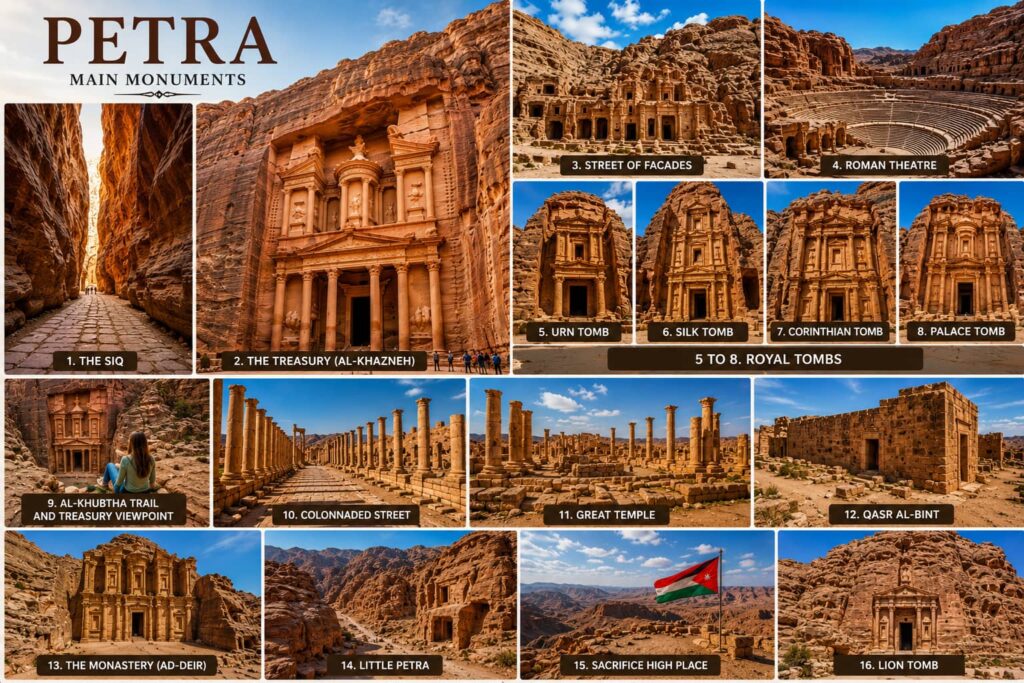
- Walk through the Siq, the narrow and winding gorge, keeping silent to hear the sounds of the wind in the rocks.
- Admire the Treasure right at the canyon’s exit, but avoid stopping for too long to escape the first influx of tourists.
- Follow the Street of Facades and visit the Royal Tombs during the soft morning light, which highlights the colors of the stones.
- Climb the eight hundred steps carved into the rock towards the Monastery in the early afternoon, taking water and provisions with you.
- Descend along the alternative trails, chatting with local residents and purchasing products from traditional Bedouin vendors.
- Finish the journey by returning calmly before sunset, collecting all the trash and waste you produced.
Following these structured steps ensures you learn the key points at your own pace, appreciating each discovery along the way. The morning walk offers pleasant temperatures, allowing for much greater physical performance while climbing the steps.
An itinerary to help you make the most of Petra
I always say that two full days is ideal for visiting and getting to know any place. There are some exceptions, like Paris, etc.
Petra is within the rules, but she needs a well-thought-out plan, as everything must be done on foot, in the desert under the hot sun, without any shade and without any alternative.
Remember that everything that goes towards the Monastery must come back walking.
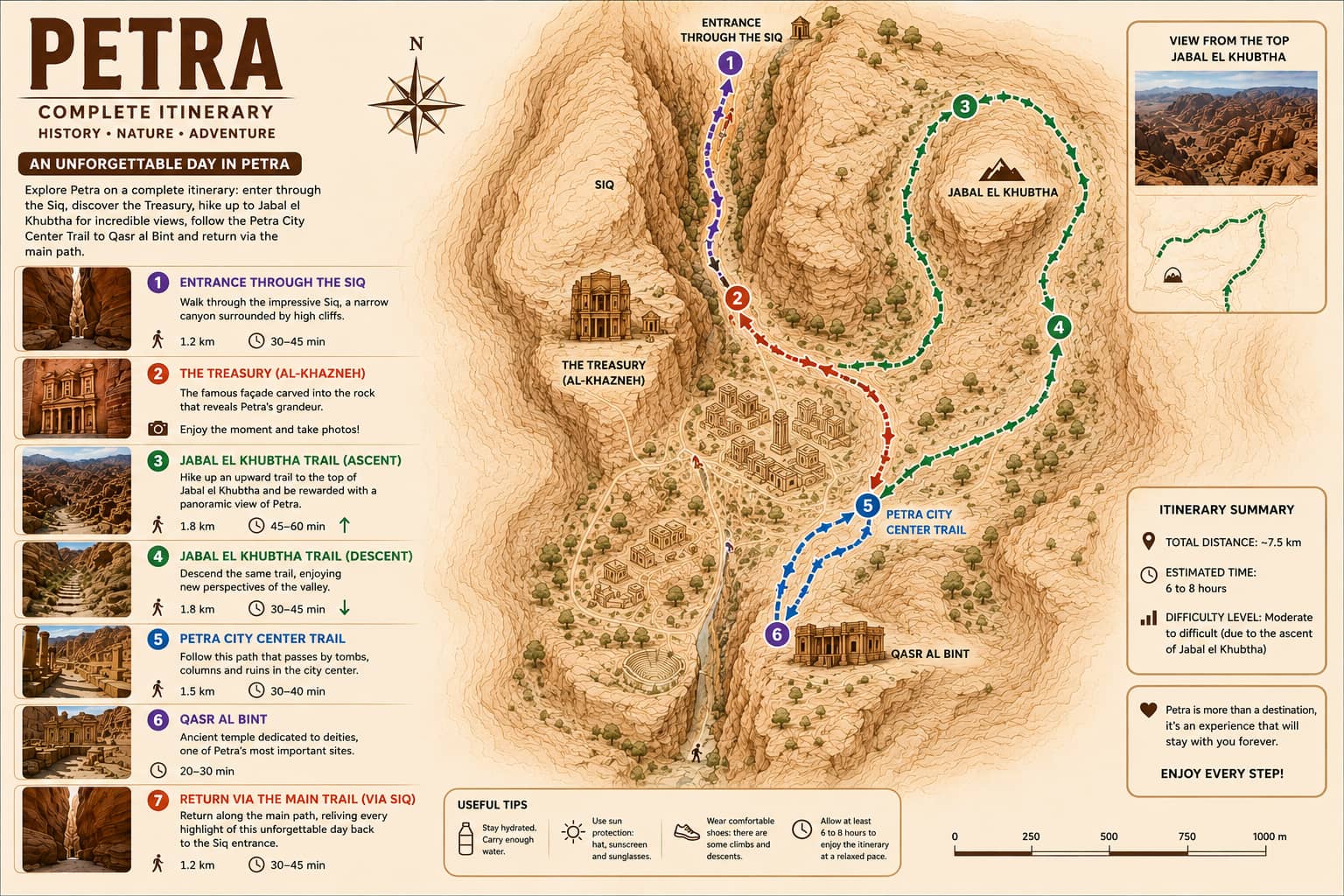
Itinerary: Day 1
Ideally, you should arrive in Wadi Musa the day before to enter Petra very early. I arrived at 7 am. Since I already had my Jordan Pass ticket, I just had to show it and go in.
In my backpack, I carried 3 liters of water, snacks for the trail, lunch, and some treats. This gave me the freedom to walk peacefully and rest wherever I wanted.
After about a 20-minute walk, the Siq begins, and soon after, the long-awaited view of the Treasury appears. The place was empty. I took many photos, refused several offers to climb the short and dangerous trails, and went straight to the Al-Khubtha trail, which allows you to see the Treasury from above.
I stopped for a snack with an incredible panoramic view of the city. Afterwards, I went down and explored the ruins up to Qasr al-Bint, one of Petra’s main monuments.
So far, including the Al-Khubtha trail, we’ve covered about 7 km and spent 6 hours exploring. Since the path to the Monastery involves a steep climb, the best plan is to turn back and rest for the next day.
OBS:The image is just a diagram. As soon as you arrive at the entrance, pick up the official map with all the city details.
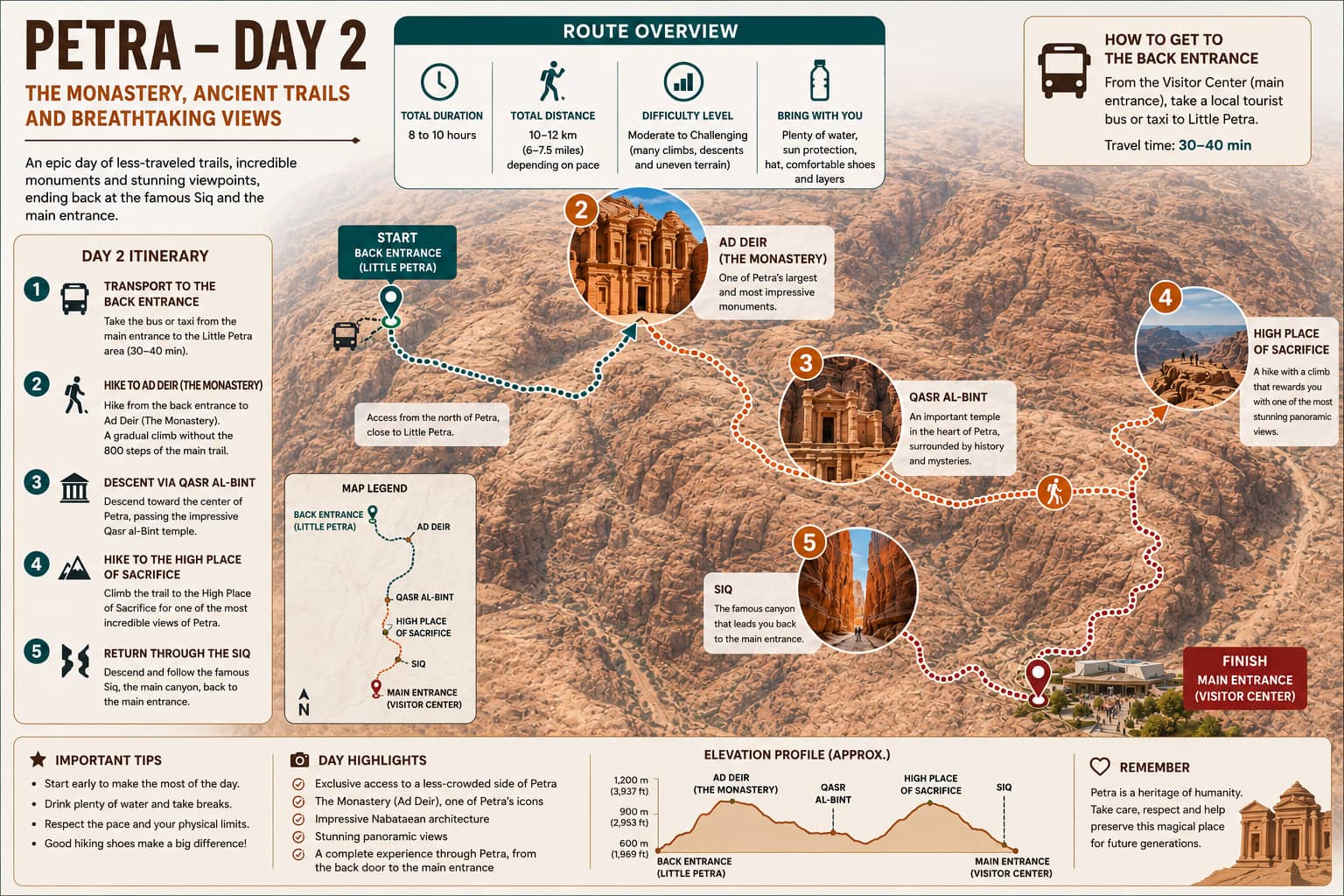
Itinerary: Day 2
Early in the morning, take the bus from the main entrance to Little Petra. After a quick visit there, a shuttle will take you to the start of the trail to the Monastery. It’s possible to walk, but the path is very long.
This strategy works very well. You get to see all the important points with less effort and almost without repeating any monuments. Furthermore, the journey becomes easier, since you avoid the constant stretching and pulling of going up and down to the Monastery; the trip becomes a constant downhill climb.
After visiting the Monastery, walk down the path to Qasr al-Bint. Instead of repeating the main street from the previous day, turn right and take the path to the Altar of Sacrifices. Go down towards the Roman Theatre and from there, follow the same path back to the main entrance.
OBS:The image is just a diagram. As soon as you arrive at the entrance, pick up the official map with all the city details.
Essential tips to make your desert experience easier.
Independent exploration gains quality when we apply small tricks that nomads have used for centuries in those arid lands. Use map applications that work completely offline to navigate secondary trails with total safety.
These alternative paths often reveal ancient altars and stunning panoramic views that most hurried visitors miss. Chat with the Bedouins who run the small tea tents along the mountain trail.
They have fascinating stories about their ancestors and offer genuine hospitality that enriches our cultural experience. Consider staying in the neighboring town of Wadi Musa, choosing family-run guesthouses that practice sustainable and community-based tourism.
These accommodations often prepare healthy snacks for your hike at much more reasonable prices than the on-site restaurants. Save energy and resources by avoiding the use of draft animals, such as camels and donkeys, which frequently suffer from overwork.
Your own legs are perfectly capable of overcoming the geographical challenges if you walk with patience and a steady pace. Wear a hat, biodegradable sunscreen, and sunglasses to protect yourself from the strong light reflecting off the sandstone walls.
Common mistakes you should avoid during your visit.
The most frequent mistake made by hurried travelers is to reserve only a single day to explore the entire archaeological area. Petra is immense, with hidden valleys and distant monuments that require time for travel and true contemplation.
Another serious misconception involves accepting services from supposed guides who promise dangerous or illegal shortcuts on the slopes of Tesouro. These practices fuel predatory informality and put your physical safety at unnecessary risk on unstable rocks.
Avoid buying antique relics or pieces of stone offered by children on park trails. This practice encourages children to drop out of school and directly contributes to the destruction of historical heritage that humanity should preserve.
Don’t underestimate the need for constant hydration, as the dry climate masks fluid loss through sweat. Waiting to buy water inside the archaeological site will increase the cost of your trip and generate plastic waste that is difficult to manage.
Never ignore the signs and warnings from local authorities regarding restricted conservation areas. Respecting park boundaries demonstrates maturity and ensures that future generations can also enjoy this extraordinary cultural richness.
Is it worth investing time and resources in this adventure?
The answer to that question is a resounding yes, provided you seek depth and inner transformation. Crossing the world to walk among monuments carved directly into sandstone mountains definitively expands our minds.
The financial investment and physical effort find immediate reward in the raw beauty of the desert and the richness of human interactions. This journey teaches us about the resilience of past civilizations and the urgency of preserving remaining traditional cultures.
Furthermore, the flexibility of a spontaneous itinerary allows the simplest moments to become the most precious memories. You’ll realize that the true value of the trip isn’t in the goods purchased, but in the conversations shared around the fire.
The simplicity of the desert acts as a mirror, making us value freedom and a true connection with the planet. Therefore, set aside your fears, pack your bags consciously, and allow yourself to live this transformative experience. The accumulated learning on these trails will shape your worldview, motivating new explorations and strengthening your spirit of freedom.
Conclusion
Visiting the fascinating Nabatean city of Petra independently and consciously represents one of life’s most liberating experiences. Throughout this article, we understand the importance of sustainable planning, resource conservation, and respect for local communities.
We’ve seen that taking things slowly and avoiding common mistakes transforms a simple tourist activity into a journey of self-discovery. Now, the next step depends entirely on your courage to break away from pre-planned itineraries and embrace the unknown.
Let the desert dust and Jordanian hospitality inspire your next great journey across our vast planet. Share your questions in the comments or send this guide to that friend who shares the same desire for freedom.
The world awaits your next steps, and the trails of history are ready to welcome your curiosity in an authentic way.
Frequently Asked Questions (FAQ)
What is the best time of year to visit the place?
The spring season, between March and May, and the autumn season, from September to November, offer ideal temperatures. During these periods, the desert heat is milder, making the long daily hikes through the sandstone mountains easier.
How much does it cost to enter and receive admission to the archaeological site?
A single-day ticket costs fifty dinares Jordanians, but the best option is to purchase the Jordan Pass. This package costs from seventy dinars and already includes the entry visa and access to the park.
Is it mandatory to hire a licensed local guide?
Hiring guides is not mandatory for walking the main routes of the old city. The visitor center provides detailed maps that allow for independent and safe exploration for travelers who prefer autonomy.
How long does it take to walk the main trails at a leisurely pace?
I recommend dedicating at least two full days to be able to walk the main and secondary routes without rushing. This time allows you to visit the Treasury, the Royal Tombs, and climb up to the Monastery while respecting your own body.