I’ve lost count of how many times I’ve heard ‘but isn’t it dangerous to travel in Brazil?’ from foreign travelers I’ve met around the world.
The short answer is: it depends on how you travel. After traveling all over the country and witnessing many situations…
What it’s like to be stuck on the Red Line highway in Rio de Janeiro due to a shootout.
A dispute between tourists and locals in Bahia over respect for religious offerings.
For those visiting Bahia for the first time, it may seem like just a superstition, but following this advice demonstrates respect for the local culture and avoids disagreements.
I’ve visited several communities (slums) without any incident, and I’ve learned that safety in Brazil is less about luck and more about habit.
Its vibrant culture, delicious cuisine, paradisiacal beaches, lush waterfalls, and adventures for all tastes, in addition to its vast territory, make the experience very special. However, it is important to be aware of the country’s security challenges to make the most of your trip.
Safety: A Brazilian Reality
According to Brazilian Forum on Public SecurityBrazil faces high levels of social inequality, which contributes to high crime rates, although the most recent Public Security Yearbook…exhibitionsA decline in several indicators in recent years.
Don’t be scared! Millions of tourists visit Brazil every year without any problems. By following the safety tips below, you will minimize the risks and have an incredible experience.
Essential Tips for Traveling Safely to Brazil.
Personal safety is a universal concern, but in Brazil, attention should be tripled.
When we are in our environment, we are aware of the problems and are already prepared to face them.
However, when we travel, we will be in an unknown place and consequently more vulnerable.
To get started, check out these articles with valuable tips:
13 Common Travel Scams.
15 Foolproof Safety Tips for Traveling in Any Country.
Preventive Measures: Always Be Alert
- Situational Awareness: Be very aware of your surroundings.
- Guidance: Know where you are and where you are going.
- Discretion: Avoid showing off valuables, such as jewelry, money, etc.
- Minimalism: Carry only what is strictly essential.
- Digital Security: Be careful with your cell phone and banking apps. Avoid using your cell phone on the street and, if possible, remove all banking apps.
- Avoid Isolated Places: Be especially careful at night and in deserted places.
- Beware of Strangers: Do not accept anything from strangers, especially at parties.
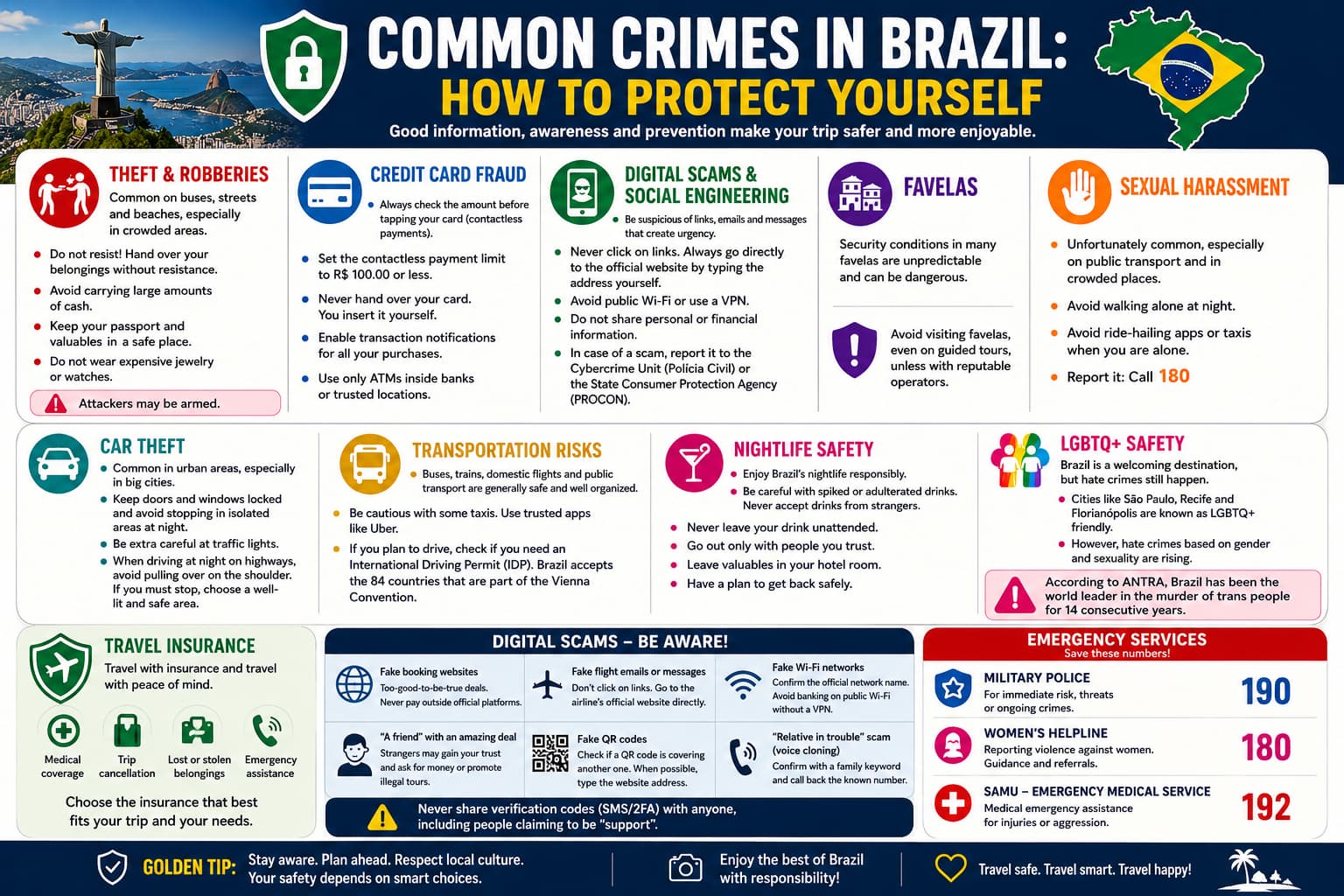
Common Crimes in Brazil: How to Protect Yourself
Robberies and Assaults:
Common on buses, streets and beaches, especially in large crowds.
This is a scene I’ve witnessed in several places. However, keep in mind that the assailants may be armed.
- Don’t fight back! Hand over your belongings without resistance.
- Avoid carrying large sums of money.
- Leave your passport and valuables in a safe place.
- Do not wear expensive jewelry or watches.
Credit Card Scams:
Brazil is among the countries with the highest fraud rates. Be aware of:
- Amounts changed, especially in contactless transactions.
- Always check the amount before tapping your card.
- Set the maximum limit for approval without a password to R$100.00.
- Physical cloning of the card.
- Never give your physical card to someone. You take the machine and insert your card yourself.
- Have contactless payment enabled, this way you avoid handing over your card.
- Activate the notification service for all transactions made with your card.
- ATM skimmers. Devices installed in ATMs to copy the card.
- Only use ATMs inside banks or trusted locations. Never expose them on the street.
- Phishing by email or messages.
- First, carefully check whether the messages or emails are genuine.
- Never click on links received in messages or emails. Always go to the website with you by typing the main website address.
Digital Scams and Social Engineering in Travel
Not all scams happen on the street. Many travelers fall victim to scams even before boarding their flight, or during their trip, through messages, emails, and social media that appear legitimate. These scams use social engineering. In other words, psychological manipulation to make you act quickly, without thinking, usually exploiting urgency, fear, or trust.
Fake booking and accommodation websites
Accommodation listings with prices that are too low, outside of official platforms (Booking, Airbnb, Hostelworld), often ask for payment via PIX or direct transfer “to guarantee the reservation”.
- Never pay outside of the official booking platform.
- Be wary of hosts who ask for urgent bookings (“I only have this spot if you pay now”).
- Check if the advertiser’s profile has real reviews and a history.
Emails and messages about flights
Messages warning about “flight cancellation,” “payment problem,” or “pending refund” often come with a link that mimics the airline’s website.
- Never click on links in emails/SMS messages about flights — access the airline’s official website by typing the address yourself.
- Legitimate airlines rarely ask for credit card details via SMS or WhatsApp.
Fake Wi-Fi in airports and hotels
Wi-Fi networks with names similar to official ones (e.g., “Airport_Free_Wifi” instead of the airport’s real name) can capture data you type while you browse.
- Confirm the exact name of the official chain with a staff member at the location.
- Avoid logging into banks or typing passwords on public Wi-Fi without a VPN.
The “friend” scam who claims to know an amazing place.
A digital variation of the in-person scam: someone adds you on social media during your trip (or even before, in traveler groups), quickly establishes trust, and then asks for financial help, suggests an “exclusive tour” outside the official circuit, or asks you to book/pay for something on their behalf.
- Be wary of any request for money, even a small amount, from recent contacts.
- Check out tours and excursions only with licensed companies — never book based on recommendations from strangers online.
fake QR codes
Common in restaurants, parking lots, and tourist attractions: a sticker with a fake QR code is pasted over the original, leading to a fraudulent payment website.
- Before scanning, check that the QR code doesn’t appear to be pasted over another one.
- When possible, type the website address manually instead of scanning it.
Link / message from “family member in trouble” (deepfake voice)
A growing scam: a phone call or audio message, sometimes using an AI-clone voice, pretending to be a family member in trouble abroad, asking for an urgent money transfer.
- Agree on a “keyword” with your family before traveling, to confirm your identity in real emergencies.
- Always try calling the person back to a known number before taking action.
How to protect yourself in general:
- Be wary of any message that creates an artificial sense of urgency (“today only,” “last chance,” “your account will be blocked”).
- Never share verification codes (SMS/2FA) with anyone, not even “support” who called you.
- If a scam is confirmed, report it to… Cybercrime Divisionfrom your region or in Procon of the state.
Learn how to understand and protect yourself fromsocial engineeringand howProtect your data while traveling.
Favelas:
To travel safely in Brazil, we often have to avoid some things.
Avoiding visiting favelas, even on tourist trips, is one of them. The security situation in many favelas is unpredictable and can be dangerous.
Sexual harassment:
Unfortunately common, especially on public transport and in crowded places. The victims are mainly women.
- Avoid walking alone at night.
- Avoid ride-sharing or taxi apps when you are alone.
Brazil has a 24-hour free hotline dedicated to assisting women who need assistance. Just dial 180
Car Theft:
Common in urban areas. Especially in large cities.
In my entire life I’ve had 4 vehicles stolen, and one of the thieves was armed.
- Keep doors and windows locked, and avoid stopping in isolated places at night.
- Be especially careful at traffic lights.
- If you are driving outside the city at night, avoid stopping on the shoulder. If you must stop, try to stop in a well-lit area.
Transportation Risks:
All types of transportation in Brazil are very safe and well organized.
- Buses, planes, and public transportation are safe.
- Be careful with some taxis regarding fares; use apps like Uber.
- If you are going to drive, check whether you need documentation.
Nightlife:
Enjoy responsibly. Brazil is very famous for its nightlife. There are options for all tastes and desires. Just like anywhere else in the world, problems are likely to occur if you are drunk.
- Be careful with adulterated drinks and do not use drugs from strangers.
- Never leave your drink unattended. Only go with people you trust;
- Leave all valuables in the room, as detailed above;
- Have a plan for how to get home;
LGBTQ+ Safety:
Brazil is a welcoming destination, but hate crimes still occur. We officially have several “gay-friendly” cities. Examples include São Paulo, Recife, and Florianópolis.
However, the number of crimes based on sex and gender has been steadily increasing.
According to ANTRA’s Dossier on Murders of Transgender PeopleBrazil has topped the world ranking for murders of transgender people for the 14th consecutive year—a fact that every LGBTQ+ traveler should know before planning their trip.“
Travel insurance:
Traveling around Brazil safely is easier if you have insurance. As with any trip, it is essential to have travel insurance. It covers both your health and your belongings. Learn how to choose the ideal insurance for your trip.
Emergency services:
If you or someone you know is in danger, don’t hesitate to ask for help! Here are the main emergency numbers:
- Military Police – 190. Use in cases of immediate risk, such as ongoing stalking, threats, or assaults.
- Women’s Assistance Center – 180. Exclusive channel for reporting violence against women. Offers guidance and can refer cases to the support network.
- SAMU (Mobile Emergency Care Service) – 192. For emergency medical care in cases of assault or injury.
Extra Tips for Your Safety
- Use secure shoulder bags.
- Be careful on the beach and do not leave your belongings unattended.
- Take only a bank card and a little cash, leave the rest in a safe place.
- Use reliable transportation apps. Uber works well in Brazil.
- Keep your passport safe and take copies.
- Take the minimum amount of belongings to parties.
- Avoid deserted places and be careful when withdrawing money.
What frequent travelers actually do
I always try to find out which places are the most dangerous and what types of dangers are most common.
An efficient way to research the safety of any destination is to follow this order:
Consult official government announcements.
Read recent news.
Search for travelogues on forums and blogs.
Upon arrival at your destination, confirm the information with locals or hotel staff.
This combination greatly reduces the chance of being surprised and allows you to adapt the itinerary to the local reality, instead of relying solely on old information or a single source.
Remember:
Prevention is the best way to ensure a safe and unforgettable trip through Brazil.
The challenges of traveling during the pandemic.
Do you have any tips? Leave your comment