What to pack for an international trip: a complete guide and essential tips
This is one of the questions I get asked most often by people who want to explore the world on international trip authentically. However, before packing your bags, we need to ask ourselves other fundamental questions that will shape your entire journey.
Ultimately, knowing what to pack for an international trip depends entirely on where you’re going and what your purpose is. The word “international” is too broad and, on its own, doesn’t say much about the real challenges you’ll encounter along the way.
The first step is to deeply understand your destination. While there are elements common to all journeys, the choices that truly matter are tied to the local culture and environment.
Preparing for the sophistication of Paris or the vibrant intensity of Islamabad is very different. Some travelers don’t even know where certain places are on a map before they embark on their journey.
Arriving in India is a completely different experience from going to a paradise beach in the Caribbean. I’m not just talking about the visual scenery, but the human interaction and the wonders of each culture.
Therefore, your planning should be immersive and spontaneous, valuing the freedom to discover the new with wisdom, respect, and curiosity.
Why researching your destination is important when traveling.
Before delving into the technical step-by-step process, it’s vital to understand why knowing your destination is the foundation of everything. On an international trip, your safety and comfort depend on prior knowledge of the territory.
When you understand local norms and customs, your integration happens more naturally and authentically. This avoids uncomfortable situations with the residents and allows for a real connection with the essence of the people.
Furthermore, knowing the spoken language and the predominant religion is a way to show respect for other cultures. Research specific health issues in the region, safety rates, and how the local cuisine works.
Understanding the transportation systems and available medical care also provides a necessary peace of mind to enjoy every moment.
We need to be prepared for the unexpected, as this will make the journey much more enjoyable and fluid. The time invested in research directly reflects the quality of your experience.
When we remove unnecessary doubts, only what is essential remains for our personal growth during the journey of discovery.
The experienced traveler’s baggage philosophy
Traveling light is an art that is perfected with time and accumulated miles. On an international trip, every extra kilo in your suitcase is an anchor that limits your freedom of movement. I’ve learned, after visiting more than 60 countries, that simplicity is the secret to a smoother journey.
When we carry fewer material possessions, we have more space for experiences and memories that truly matter. Furthermore, a compact bag makes using public transportation, such as trains and buses, easier and more sustainable.
Therefore, decluttering should begin at home. Choose versatile clothing items that can be mixed and matched and are suitable for the destination’s climate. Prioritize fabrics that dry quickly and don’t wrinkle easily. Remember that in most places around the world, you’ll find laundromats.
There’s no need to pack a whole wardrobe for two weeks away. Taking only the essentials reduces stress at the airport and avoids exorbitant excess baggage fees.
Sustainability in travel begins with how we consume space and resources.
Less weight means less fuel spent on transportation and more energy for you to walk through the historic streets.
What you need to know before you begin.
Before starting the practical preparations for your international trip, define a realistic and detailed budget. On journeys across borders, costs are usually higher and uncertainties are constant.
The exchange rate is a determining factor, especially given the volatility we face at certain times.
Therefore, plan your finances carefully to avoid unpleasant surprises that could prematurely interrupt your dream.
Another crucial point is the climate and seasonality of the chosen location. Depending on the destination, conditions may be the opposite of what we are used to in the southern hemisphere.
I’ve faced temperatures of -30 degrees Celsius in Alaska, as well as icy winds and a freezing -17 degrees Celsius while observing the Northern Lights in Rovaniemi.
On the other hand, I have experienced extreme heat of 45 degrees Celsius during the European summer, which has become increasingly intense. Research seasonal forecasts and only pack what is necessary for that specific context.
Having digital price comparison tools is also essential for obtaining real and up-to-date figures on each item in your journey.
Prior technical knowledge is what allows for safe spontaneity the moment you step onto foreign soil.
Step 1: Airline tickets and internal transportation
Planning an international trip starts with the logistics of how to get there and how to get around. Use platforms like Skyscanner or Google Flights to monitor flight prices in advance.
I recommend setting up price alerts to identify the best buying opportunities. Often, flying to a neighboring city and continuing by land can result in significant savings and an extra adventure along the way.
In addition to flights, also consider the costs of domestic trains, buses, or even car rentals.
In Europe, for example, the rail system is excellent and offers a privileged view of the rural landscapes. Renting a car can be ideal for exploring regions like Patagonia or the Icelandic countryside, where public transport is scarce.
However, always consider the environmental impact of your choices. Prioritizing public transportation is a way to practice more ecological and conscious tourism. Always have your digital tickets and a printed copy on hand in case your phone battery dies.
Freedom of movement is what allows you to find those authentic places off the beaten track.
Step 2: Purposeful and connected hosting
The choice of where to stay on an international trip directly impacts your cultural experience. Check websites like Booking or Airbnb, but try to look beyond the price.
Family-run guesthouses or hostels often offer a deeper connection with the local community. In these places, you exchange stories with other travelers and receive valuable tips from the hosts that no traditional tour guide could provide.
Always check for extra charges, such as municipal tourist taxes, which are common in cities like Venice, Paris, or Lisbon. They usually range from €1 to €15 per day. To save money sustainably, look for places that allow the use of the kitchen.
Preparing meals with ingredients bought at local markets is a unique sensory experience. You learn about local produce and significantly reduce your daily expenses. Furthermore, staying outside the main tourist center can be cheaper and offer a more authentic glimpse into the daily lives of locals. Accommodation shouldn’t just be a place to sleep, but a support point for your cultural immersion.
Step 3: Travel insurance and health care
This item is absolutely non-negotiable on any international trip. Travel insurance is your guarantee of medical, hospital, and even legal assistance in case of unforeseen events.
I would never consider crossing a border without this minimum coverage. I’ve witnessed situations where simple incidents resulted in hospital bills of thousands of dollars. Insurance offers the peace of mind of knowing you will be assisted with dignity in any adverse circumstance.
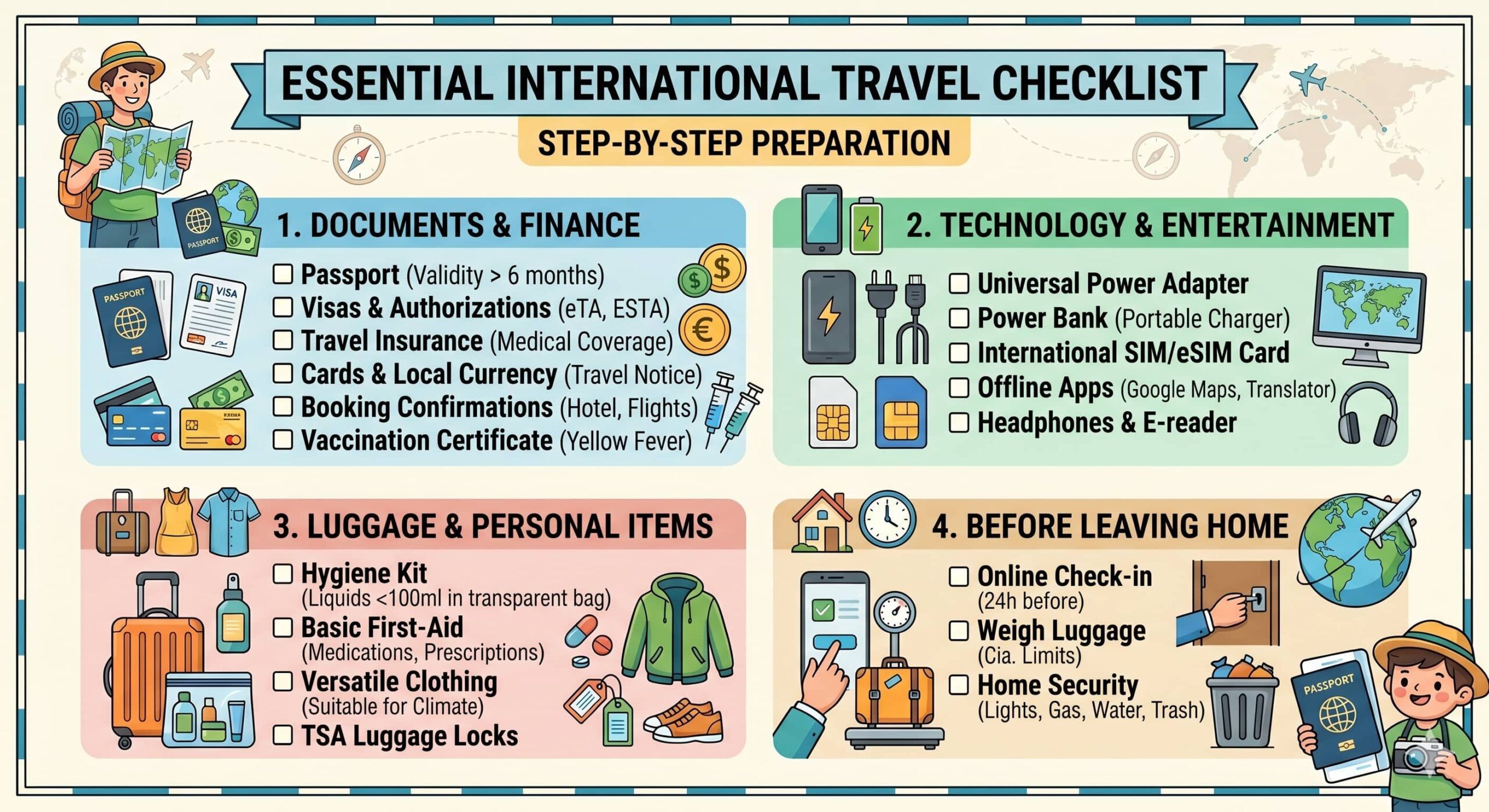
Also check the health requirements of your destination. Many countries require the International Certificate of Vaccination (ICVP) for yellow fever or other specific diseases.
Keeping your vaccination records up to date is an act of responsibility to yourself and to the local population. In addition, put together a small kit of essential first-aid and common symptom medications.
Bring your prescriptions for any regularly used medications to avoid problems at customs. Your health is your most precious asset; without it, no adventure can be fully enjoyed. Investing in prevention is the smartest choice a traveler can make.
Step 4: Bureaucracy, documents and visas
Your passport is your most valuable document when traveling internationally. It must be valid for at least six months from the date of entry into your destination country.
Many travelers are prevented from boarding due to neglecting this technical detail. Additionally, consult official consular websites to verify the need for tourist visas or electronic travel authorizations (such as eTA or ETIAS).
Organize your authorizations in advance, as some processes can take weeks. Having a digital folder with copies of all documents (passport, insurance, reservations) in your email or in the cloud is essential.
I also recommend keeping physical copies hidden in your luggage as a backup. If you intend to drive abroad, check if your Brazilian driver’s license is accepted or if you need an International Driving Permit (IDP).
Keeping your paperwork in order avoids stressful interruptions and allows for a smooth and quick transition across borders. Organized documentation is the key to staying focused on having fun and exploring.
Step 5: How to get through customs and security
Airport security and customs procedures often represent the most stressful moment for those traveling internationally who decide to explore the world.
Many people feel it’s an obstacle, but ideally, they should see it as a necessary process for their own safety.
With proper preparation, queues and inspections cease to be a problem and become just a brief part of your journey into the unknown.
The most important thing is to make sure you have checked all the requirements, documents, and prohibitions, both for your country and for your destination.
Before arriving at the airport, you should organize all your documents and belongings strategically.
Make sure your passport is valid for at least six months and that all necessary visas are in order.
In addition, it is essential to check the specific rules of the destination country regarding prohibited or restricted items, such as medications.
Another important point involves the physical organization of your luggage to facilitate screening. Use reusable bottles for liquids, always respecting the limit of 100 milliliters per container on international flights.
Keep laptops, tablets, and cameras in places where you can easily remove them. Remember that using bags with TSA-approved locks makes inspection easier without damaging your luggage.
Having your documents, such as proof of accommodation and return tickets, printed or saved on your phone helps with communication with customs. By preparing in advance, you demonstrate that you are an experienced traveler who is aware of your responsibilities.
Finances: How to manage money abroad
Financial planning is what keeps your international trip alive for longer. Nowadays, there are much more advantageous options than old-fashioned cash or traditional credit cards.
International debit cards, such as those from Wise or Nomad, use the commercial exchange rate and much lower IOF (tax on financial transactions) rates. This generates real savings that can be converted into more travel days or special gastronomic experiences.
However, it’s wise to always carry a small amount of local currency. In remote areas, street markets, or small cafes, cards may not be accepted. Research the tipping culture of your destination to avoid social faux pas.
Another important tip is to inform your bank about your trip to avoid your cards being preemptively blocked abroad. Monitor your spending daily using financial management apps.
Economic sustainability allows you to travel with peace of mind, knowing that your resources are being well used. Every penny saved intelligently is a step closer to your next destination.
Connectivity and internet on international trip
Staying connected while traveling internationally has gone from being a luxury to a safety and logistical tool. Having internet access allows the use of real-time maps, instant translators, and local transportation apps.
The most efficient and sustainable way to ensure this is through eSIM. Companies like Airalo. They offer digital plans that can be activated even before you leave Brazil.
The eSIM eliminates the need to buy disposable plastic chips in each country, which reduces waste generation. You keep your Brazilian WhatsApp number active and simply use your international data plan to browse.
If your phone is not compatible with the technology. When you arrive, try to buy a local SIM card. Avoid international roaming charges from Brazilian carriers, as the costs are usually astronomical. Being connected makes it easier to communicate with family and allows you to share your discoveries in real time, keeping your loved ones at ease while you explore new horizons.
Food and sustainability in the kitchen
Eating out for every meal during an international trip is a habit that significantly impacts the budget. One strategy I always recommend is to take advantage of the kitchen at your accommodation.
Visiting local supermarkets and markets is a fascinating cultural activity. You discover exotic fruits, different spices, and eating habits that don’t appear on the menus of tourist restaurants.
Preparing your own breakfast or a light dinner represents a tremendous saving. Furthermore, going on excursions with practical snacks and a reusable water bottle in your backpack avoids inflated costs.
Drinking tap water in countries where it is potable is an excellent way to save money and reduce the use of plastic bottles. I always carry my filter kit so I can use tap water anywhere.
You can save a lot of money just by drinking pure water. link
Leave dinners at award-winning restaurants for special celebratory occasions. That way, every meal out becomes a memorable event, not just an expensive necessity.
Eating mindfully helps your wallet and reduces the ecological footprint of your journey around the world.
Security and prevention of common scams.
While we seek the beauty of the world, we cannot ignore that safety is a priority on international travel. In many places, tourists are seen as easy targets for petty theft or elaborate scams.
Do some research beforehand about the most common scams in your destination. Whether it’s the ring scam in Paris or exorbitant taxi fares in Bangkok, being informed is your best defense.
Use money belts to keep your passport and the bulk of your money close to your body. Avoid displaying valuables or expensive photographic equipment in isolated areas.
The golden rule is act like a local whenever possible. Walk confidently and avoid showing that you’re lost in the middle of the street; stop into a café to look up a map if necessary.
Safety doesn’t mean being afraid but rather being prudent so that nothing interrupts the flow of your adventure. Respect your instincts and avoid situations that seem too good to be true.
11 Mistakes That Make Your Trip Costly: Find Out How to Avoid Them.
The importance of an emergency fund in international trip.
Every experienced traveler knows that the unexpected is part of the journey. Therefore, maintaining an emergency fund is vital on an international trip. This amount should be kept separate from your daily budget and used only in critical situations. It serves to cover expenses such as last-minute flight changes, unforeseen health problems, or loss of essential equipment.
Having this emotional and financial safety net allows you to remain calm in the face of any adversity. In addition to money, the contact information for the nearest Brazilian consulate and local emergency numbers were noted.
Not everything can be predicted, but being prepared for the worst ensures you can enjoy the best with a light heart. Financial sustainability is what allows you to stay on the road for months, turning challenges into stories of overcoming adversity.
View your finances as the fuel that powers your personal growth through travel.
How to pack: the layering method
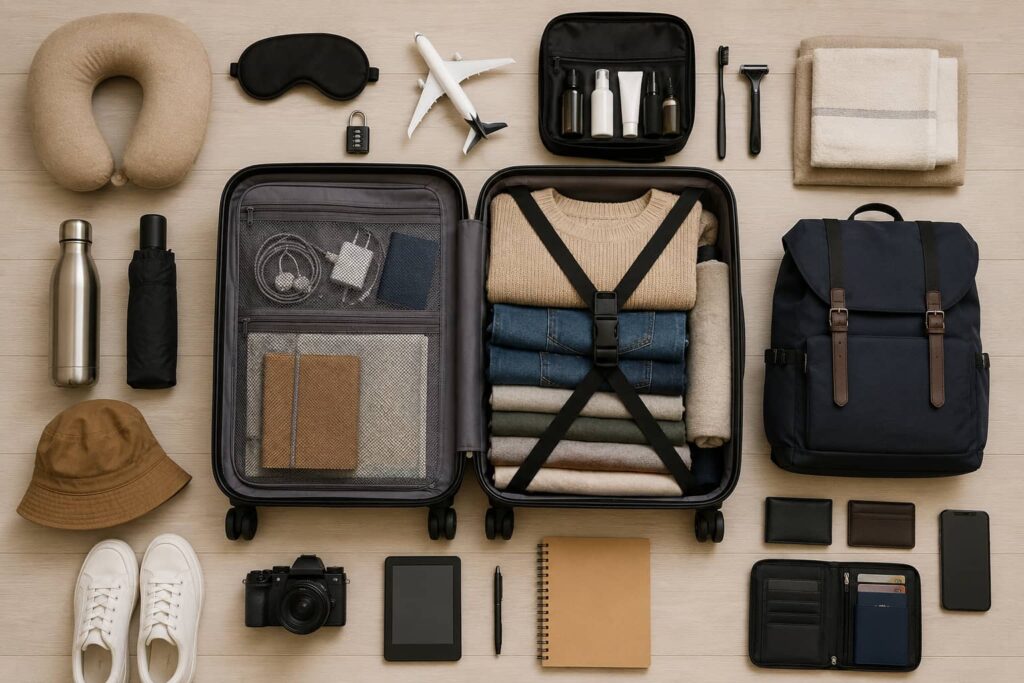
Packing for an international trip requires strategy, especially if you’re facing varied climates. The layering method (or “onion system”) is the most efficient. Start with a thermal base layer if you’re going to a cold place, add insulated pieces, and finish with a windbreaker or waterproof layer. This allows you to quickly adjust to temperature changes throughout the day without having to carry heavy coats all the time.
Use packing cubes to separate your clothes by category. This helps keep your suitcase organized and makes it easier to find what you need without having to rummage through everything.
Remember to leave a little space for any authentic souvenirs you might find along the way. Avoid bringing “just in case” items that you’ll never use. If you need something very specific, you can almost always buy or rent it at your destination.
And most importantly, especially on an international trip: Never, ever, take anything for anyone you don’t know and who hasn’t opened and personally checked what you’re taking.
Traveling with only the essentials is a form of detachment that frees the mind to focus on what is invisible to the eyes, but essential to the heart.
Sustainability and ecological awareness on the road.
Traveling the world brings the responsibility of preserving the places we visit. On an international trip, our individual choices have a collective impact. Try to reduce your use of disposable plastics by bringing your own cutlery kit and reusable straw.
Choose tour operators that respect the environment and local communities, avoiding animal exploitation or the degradation of natural monuments.
Respect waste disposal rules and conserve energy in the places where you stay. Sustainable tourism is not just about nature, but also about supporting the local economy.
opt for buying handicrafts directly from producers and eating at small, family-run establishments. These small actions ensure that destinations remain authentic and vibrant for future generations of explorers.
Traveling consciously is the only way to ensure the world remains vast and full of life. Be a traveler who leaves only light footprints and takes with them only profound lessons and memories.
The impact of culture and human interaction.
What truly defines an international trip isn’t the monuments you photograph, but the people you meet. Human interaction is the soul of any discovery.
Try to learn some basic words in the local language, such as “hello,” “please,” and “thank you.” This small gesture opens doors and brings smiles, transforming a business transaction into a moment of genuine connection.
Be open to hearing the stories of the locals. Sometimes, a conversation on a park bench or at a street market teaches you more about life than any renowned museum.
I was in Guilin, China, sightseeing when a lady asked me where I was from, speaking in very basic English. We chatted for hours, and she showed me a side of China I hadn’t known before. She followed me throughout my trip to China until she lost contact with me because she couldn’t travel outside the country.
Authenticity lies in the simplicity of spontaneous encounters. Value the freedom to get lost in less touristy neighborhoods to observe the city’s true rhythm.
These immersive experiences are what shape our worldview and make us more empathetic and tolerant people.
The experienced traveler knows that the best souvenir is the wisdom gained through dialogue with others who are different.
Managing expectations and unforeseen events.
No international trip is perfect, and that’s what makes it interesting. Flights can be delayed, the weather can turn bad, and you can get lost on your way to the hotel. How you handle these unexpected events defines your maturity as a traveler.
Instead of getting frustrated, try to see the setback as an opportunity to discover something new. Maybe that café where you took shelter from the rain is the best in town.
Maintaining a positive attitude and resilience is key. Things won’t always go as planned, and that’s okay. Spontaneity is the mother of the best memories.
When we let go of rigid control over every minute of the journey, the universe often rewards us with magical experiences.
I’ve been to many amazing places without planning, just based on a good tip from a local.
Learn to laugh at your own mistakes and the absurd situations that only happen to those who dare to leave home. What matters is the lesson learned and the ability to move forward with a renewed spirit.
The journey reflects life: full of twists and turns, but always worth the effort of the walk.
Home organization and peace of mind
One aspect often overlooked on a long international trip is managing the life you leave behind. To travel with peace of mind, you need to ensure your home and obligations in Brazil are in order. Set up automatic payments for your essential bills and schedule future payments.
If possible, ask someone you trust to check your mail and the condition of your home periodically.
This avoids unnecessary worries while you’re on the other side of the world. Settling bureaucratic matters before departure frees up mental space for contemplation and learning.
Nothing disrupts the flow of a day more than receiving a billing notification or having a service cut off due to forgetfulness. Organize your home life with the same dedication you organize your purse.
When everything is peaceful behind the scenes, you have all the energy you need to fully immerse yourself in the new cultures and experiences that await you.
The return and integration of the experience
The journey of an international trip doesn’t end when you land back home. The process of integrating the lessons learned is continuous. Take time to organize your photographs, write your stories, and reflect on how that experience changed your perception of the world. Sharing what you experienced with others is a way to inspire new adventurers to seek their own paths.
Often, returning home brings a certain melancholy, but embrace it as a sign that the journey fulfilled its purpose of personal growth. Apply these new habits of conscious consumption and simplicity to your daily life. The true journey is the one that transforms us from within.
Keep the flame of curiosity burning and start dreaming about your next destination. The world is too vast to be seen only once.
Each return is, in fact, the beginning of preparation for the next discovery.
Is it worth investing time in planning?
Without a doubt, dedicating time to planning your international trip is what separates a frustrated tourist from a fulfilled traveler. Planning isn’t a prison, but rather the foundation that gives you the confidence to be spontaneous. When you know your documents are in order and your budget is under control, you have the mental freedom to say “yes” to an unexpected adventure that comes your way.
Following these guidelines allows you to have an immersive and authentic experience, while respecting your budget and the planet. Sustainability and smart economics are not just about saving money, but about gaining autonomy.
Traveling in a simple and organized way is the shortest path to a life rich in stories and human connections. The investment in organization pays off twofold in the form of moments of pure joy and worry-free discovery.
Conclusion
Planning what to pack for an international trip is the first chapter of a book you write yourself, step by step. By focusing on the essentials, respecting local cultures, and preparing for the unexpected, you open the doors to the extraordinary.
I hope this comprehensive guide has provided the clarity you need to pack your suitcase with confidence. Remember that the most important item you can take with you is an open mind and a willing heart to be transformed.
The world is full of stories waiting to be lived by you. Have a good journey, and may each border crossed be a new horizon of self-knowledge and peace.
Frequently Asked Questions (FAQ)
What is the ideal time to start planning an international trip?
I recommend starting your research six to eight months in advance, especially for flights and complex visa applications. If you’re going to the United States, one or two years in advance.
Can I use my credit card insurance?
Yes, as long as you read the policy carefully. Many require that the ticket be purchased entirely with the card and may have limited coverage.
How to deal with the language barrier?
Applications like Google Translate (with offline mode) are excellent. However, gestures, smiles, and the effort to speak basic words resolve most situations.
Is it safe to travel internationally alone?
Yes, as long as you choose destinations that match your experience level, keep someone informed of your whereabouts, and follow basic local safety rules.
How can I minimize the environmental impact of my trip?
Avoid short-haul flights when trains are available, use reusable water bottles, stay in eco-certified accommodations, and respect the local flora and fauna.
How much time in advance should I arrive at the airport for an international flight?
The average arrival time at the check-in counter for international flights is 3 hours. Depending on the size of the airport, it’s best to arrive earlier.
After check-in, go straight to the customs line, which can also take a while. Just relax when you’re at the boarding gate.